|
STRATO BRIEF
SPACE · POLICY · DEFENSE
July 16, 2026
8 stories · ~5 min read
|

|
|
Geopolitics & Defense
In his final public address as chief of space operations, Gen. Chance Saltzman warned that any conflict extending into orbit would put the satellites of every nation at risk. Speaking in London, he argued that the best way to deter a space war is to field military forces that can fight and prevail there if deterrence fails. Saltzman cast the Space Force’s recent evolution as a shift from a support organization toward one explicitly preparing for competition with China and Russia. He also urged allies to share responsibility for keeping the space domain safe, secure and stable because orbital mechanics would spread the consequences of conflict far beyond the combatants.
Why it matters: Saltzman’s remarks sharpen the allied case for resilient constellations, coalition planning and space warfighting readiness as orbital competition intensifies.
|
|
|
Space Operations & Technology
|
LAUNCH
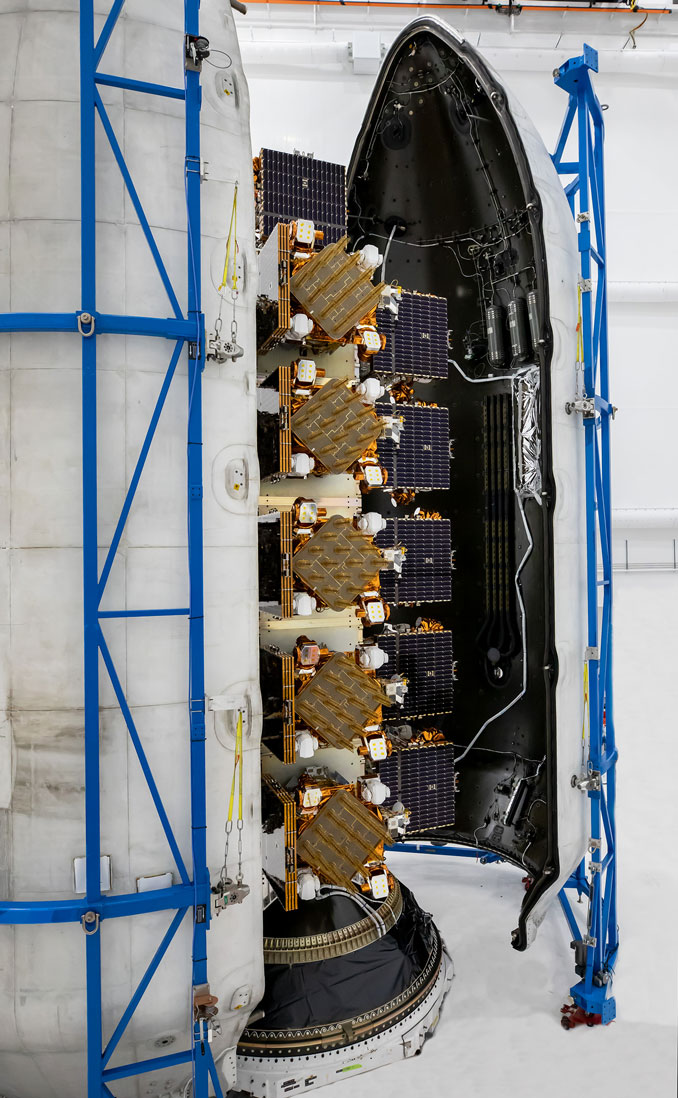
SpaceX is preparing to launch 21 Tranche 1 Transport Layer satellites for the Space Development Agency from Vandenberg Space Force Base. The spacecraft will expand the Proliferated Warfighter Space Architecture, a mesh network designed to provide secure, low-latency communications for U.S. and allied forces worldwide. The mission continues SDA’s push to field proliferated orbital infrastructure that can better withstand disruption than a small number of exquisite satellites.
Why it matters: Each added Transport Layer launch increases the resilience and scale of the military’s proliferated space communications backbone.
|
|

DEBRIS
Florida startup Satellite Orbital Access and Removal, or SOAR, has partnered with the University of Texas at El Paso to develop a passive system for capturing small orbital debris. The concept targets fragments 10 centimeters across or less using a rotating, multi-panel structure with layered shielding and onboard sensors to record impacts. Company and university officials say the goal is to mature mitigation technology before the density of small debris turns today’s low-probability strikes into a broader operational hazard.
Why it matters: Small-debris mitigation is becoming operationally urgent as even tiny impacts can disable satellites that underpin civil and military services.
|
|
|
|
Policy & Politics
|

POLICY
The Office of Space Commerce used a House Science subcommittee hearing to defend its proposed mission-authorization framework for novel commercial space activities. Officials said the voluntary Space Commerce Certification model would give companies a clearer path for activities such as satellite servicing and commercial stations that do not fit neatly under existing FAA or FCC licensing regimes. The office argued that without a defined process, U.S. firms risk regulatory uncertainty just as new business models are moving from concept to deployment.
Why it matters: A workable mission-authorization regime could determine whether emerging U.S. space businesses scale domestically or face years of regulatory delay.
|

BUDGET
Vice President JD Vance and White House aides pressed House Republicans to back a $95 billion reconciliation package that would fund the Iran war, farm aid and voter-ID measures. The House Budget Committee planned to mark up the fiscal 2027 budget resolution even as support inside the GOP remained uncertain. The proposal would advance a major defense spending increase, but internal disputes over both budget tactics and election-related provisions threatened to complicate the package’s path.
Why it matters: Congressional maneuvering around reconciliation will shape how quickly defense and national-security priorities can be funded outside the regular appropriations process.
|
|
|
Aerospace Industry
|

FUNDING
Swissto12 said it raised $70 million in Series C financing to expand production of its HummingSat small geostationary satellites and related payload hardware. The company said it already has more than $500 million in contracts spanning antennas, multi-orbit payloads and seven HummingSat orders, including a spacecraft for SES slated for completion in 2027. The funding reflects continued demand for more affordable GEO platforms as operators look for alternatives to traditional, much larger spacecraft.
Why it matters: Fresh capital for smaller GEO buses points to continued market appetite for cheaper, more flexible geostationary capacity despite LEO competition.
|

NAV
Ars Technica reported that California-based Xona Space Systems is preparing to launch the first six production satellites in a low-Earth-orbit navigation network this October, with early service expected in 2027. The company says its planned 258-satellite Pulsar constellation would deliver signals roughly 100 times stronger than GPS, improving positioning in dense urban terrain, indoors and in jamming-prone environments. Xona is pitching the architecture as both a commercial navigation product and a more resilient alternative or complement to traditional higher-orbit PNT systems.
Why it matters: A credible LEO-PNT entrant could reshape navigation markets while offering civil and military users stronger, harder-to-disrupt signals.
|
|
|
Geopolitics & Defense
|

NATO
A Royal Air Force official said Britain’s new F-35A purchase was not made for the aircraft’s dual-capable nuclear mission, despite London’s parallel pledge to re-enter NATO’s nuclear role. The statement introduced new uncertainty about how the United Kingdom intends to restore that mission and whether the F-35A fleet will eventually support it. The clarification came at a moment of heightened allied attention to deterrence, force posture and burden-sharing across Europe.
Why it matters: Questions around Britain’s nuclear-role planning affect NATO signaling, allied force structure and expectations for European burden-sharing.
|
|
|
|
|
STRATO BRIEF
|