|
STRATO BRIEF
SPACE · POLICY · DEFENSE
July 21, 2026
9 stories · ~5 min read
|

|
|
Geopolitics & Defense
KBR said it is reorganizing its defense-technology business to compete for work on the Trump administration's planned Golden Dome missile-defense architecture. The company is assigning dedicated leadership and increasing internal investment in modeling, simulation, prototyping and secure integration facilities. KBR is already part of the Missile Defense Agency's SHIELD contract vehicle and says it wants to focus on the engineering and data-integration work needed to connect satellites, terrestrial sensors, command-and-control networks and interceptors. The move highlights how prime contractors are reshaping portfolios around a multi-layer homeland defense buildout that spans space and terrestrial systems.
Why it matters: Golden Dome is emerging as a major demand signal for space-enabled missile warning, sensing and integration work across the defense industrial base.
|
|
|
Space Operations & Technology
|

TECH
Japan's IHI signed an agreement with Finland's Kuva Space to explore adding next-generation hyperspectral satellites to IHI's planned 100-satellite sovereign Earth-observation constellation. The arrangement could lead to Kuva's Hyperfield-2 spacecraft being built and operated in Japan, with orders potentially starting in 2027. Kuva says the system would extend sensing into short-wave infrared, improving the ability to identify materials and detect anomalies for security and dual-use missions.
Why it matters: The deal points to growing demand for sovereign, multi-sensor constellations that blend commercial technology with national-security requirements.
|
|

TECH
Turin-based ORiS raised 5 million euros to advance a laser-based system that beams power from one satellite to another without modifying the receiving spacecraft. The company says it has already tested the concept on the ground by powering drones at 100 meters and plans in-space demonstrations in 2027, including one with Dcubed. ORiS says the funding will help turn the concept into a practical orbital capability for spacecraft with tight power margins.
Why it matters: If it works in orbit, power beaming could expand mission endurance and flexibility for satellites without waiting for larger onboard power systems.
|
|
|
|
Policy & Politics
|

POLICY
The UK Space Agency and Space Florida each committed $200,000 to support joint research, innovation and commercialization projects under a new memorandum of understanding signed at Farnborough. The partnership will begin accepting applications this fall for funding in 2027 and marks the first deal under Florida's International Aerospace Innovation Fund. Eligible projects must include a Florida aerospace participant, an international partner and a clear commercialization path.
Why it matters: The agreement shows how regional and national governments are using targeted cross-border funding to accelerate dual-use space development.
|

DEFENSE
The Pentagon identified Sgt. Michael Emmanuel Swinton, 30, of Fayetteville, North Carolina, as the U.S. service member killed during a controlled detonation of unexploded ordnance from a downed Iranian one-way attack drone at Erbil Air Base in Iraq. The Hill reported the identification Tuesday as U.S.-Iran hostilities continue to frame Washington's regional posture and force-protection decisions. The incident underscores the continuing operational risk from low-cost one-way attack systems even after they are intercepted or brought down.
Why it matters: The episode keeps force protection, regional escalation and counter-drone policy at the center of the U.S. defense agenda.
|
|
|
Aerospace Industry
|

FUNDING
Munich-based deltaVision raised 10.2 million euros to expand production of spacecraft valves and propulsion components, citing strong demand and a constrained supply chain. The company says the round will help scale output to 5,000 units per year and support work with more than 60 customers, including major primes and government agencies. DeltaVision also wants to use the investment to push further into in-orbit refueling systems built on a modular, interoperable technology stack.
Why it matters: More capital for propulsion-component manufacturing addresses a supply-chain bottleneck in satellite production and future servicing architectures.
|
CONTRACT
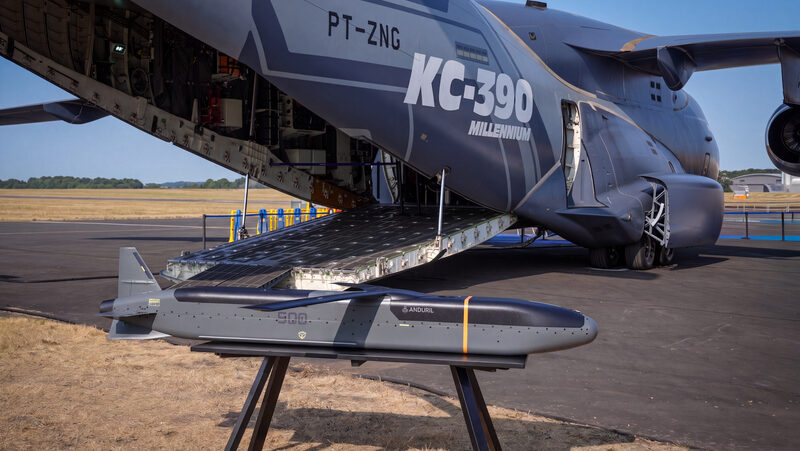
Embraer and Anduril signed an agreement to pursue integration of Anduril's Barracuda-500M palletized cruise missile on the C-390 Millennium transport aircraft. Embraer said the effort would give the platform an offensive weapons option for the first time and said interest is already coming from customers in Europe and Asia. The companies did not provide a test timeline, but Embraer said it expects Anduril's development approach could move quickly.
Why it matters: The project reflects rising demand for adaptable, lower-cost strike options that can be added to existing airlift fleets.
|
|
|
Geopolitics & Defense
|

DEFENSE
At the Farnborough Airshow, Lockheed Martin unveiled the PAC-3 Adapted Capability Effector, a lower-cost Patriot interceptor intended to defeat cruise missiles and short-range ballistic missiles at roughly half the per-unit price of the PAC-3 MSE. MBDA also introduced a low-cost interceptor derived from its ground-launched ASRAAM for use against drones, helicopters and cruise missiles. Both launches were framed around the need to expand affordable air and missile defense capacity as demand for interceptors rises.
Why it matters: Cheaper interceptors are critical if Western militaries want enough magazine depth to handle mass drone and missile threats.
|

LAUNCH
The Space Force sharply expanded the ceiling on the Lane 1 portion of its National Security Space Launch Phase 3 program, authorizing up to $17 billion in procurement there and pushing the broader launch portfolio toward $30 billion. Ars Technica reported that the move reflects rising Pentagon demand for military satellite launches ranging from experimental rideshares to higher-priority national security missions. The structure keeps Lane 1 open to a broader set of commercial launch providers while preserving tighter certification requirements for the most sensitive missions in Lane 2.
Why it matters: The enlarged launch ceiling signals sustained military demand for resilient access to orbit and broader use of commercial providers.
|
|
|
|
|
STRATO BRIEF
|