|
STRATO BRIEF
SPACE · POLICY · DEFENSE
July 23, 2026
9 stories · ~5 min read
|

|
|
Policy & Politics
A new GAO review found that 25 of NASA’s 36 major projects in development reported operational impacts from the loss of roughly 22% of the agency’s civil servant workforce over the last year. The report highlighted staffing strain on Orion, SLS and the DAVINCI Venus mission, with some programs struggling to fill key positions or revise planned risk-reduction work. GAO said the workforce is now out of balance with NASA’s program needs, even if cost and schedule effects have not yet fully materialized across the portfolio.
Why it matters: NASA’s shrinking workforce is becoming a strategic execution risk for major civil-space programs that feed U.S. launch, exploration and industrial capacity.
|
|
|
Space Operations & Technology
|

SATCOM
Poland agreed to invest about $745 million in the European Union’s IRIS² secure-connectivity program, funding six medium Earth orbit satellites and six low Earth orbit satellites. Warsaw framed the move as a security investment that would strengthen sovereign communications in crises while opening work for more than 400 domestic space-sector companies. The commitment adds industrial and political weight behind Europe’s multi-orbit answer to Starlink.
Why it matters: The deal strengthens Europe’s push for resilient sovereign satcom while expanding the allied industrial base behind IRIS².
|
|

LAUNCH
SpaceX scrubbed a July 23 launch attempt for Starship Flight 13 because of weather and shifted the next try to July 24. The company spent the week replacing and testing multiple Raptor engines on Super Heavy after the post-ignition abort during the prior attempt. The new launch window keeps the program moving, but also underscores how much engineering margin and pad tempo still matter for the vehicle’s test campaign.
Why it matters: Starship’s test cadence remains central to U.S. heavy-lift capacity, defense launch options and future high-volume space logistics.
|
|
|
|
Policy & Politics
|
POLICY
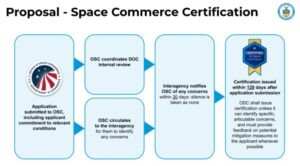
The Department of Commerce said it will soon publish a federal call for interest for its proposed Space Commerce Certification process, a step toward formal oversight for novel commercial space activities. The Office of Space Commerce has been refining the concept since late 2025, presenting it as a faster, lighter-touch pathway built around a presumption of approval. The move does not fully resolve the long-running mission-authorization gap, but it gives industry a clearer route into government review.
Why it matters: A workable mission-authorization regime would reduce regulatory uncertainty for new U.S. commercial space missions and shape investment and deployment timelines.
|

CONGRESS
The House voted 214-208 for a nonbinding resolution calling on President Trump to end the Iran war, while the Senate fell just short of advancing a binding measure that would have halted U.S. involvement. Even with different outcomes, both votes showed continued pressure in Congress to narrow or end the conflict. The debate keeps defense posture, regional escalation risk and executive war powers at the center of the legislative agenda.
Why it matters: Congressional pressure on Iran war authorities could affect force posture, contingency planning and defense appropriations across the region.
|
|
|
Aerospace Industry
|

INDUSTRY
Airbus executives said their turnaround effort in the company’s space business is beginning to pay off just as European demand rises for satellite systems, secure connectivity and military constellations. Leadership tied the recovery to tighter program discipline after major charges on earlier space programs, including OneSat. Airbus also linked the rebound to broader institutional demand from ESA, IRIS² and defense customers.
Why it matters: A healthier Airbus space division would give Europe more capacity to deliver sovereign satellite and defense programs at scale.
|

FUNDING
Space industry veteran Mark Matossian helped launch Whipsmart Ventures, a fund aimed at backing space and deep-tech companies trying to bridge the gap between prototype success and commercial scale. The firm said it wants to focus on the underfunded middle ground between seed capital and later-stage rounds, where many startups struggle to cross the so-called valley of death. Matossian argued that stronger financing and coaching at that stage can keep technically promising firms alive through cyclical downturns.
Why it matters: New venture capital aimed at scaling-stage companies could help sustain the pipeline of emerging space suppliers and technologies.
|
|
|
Geopolitics & Defense
|

DEFENSE
Taiwan’s Coast Guard Administration took delivery of Penghu, the fifth vessel in a six-ship class built under a larger 2018 program to expand patrol capacity against Chinese pressure at sea. The cutter adds endurance and significantly more firepower, including a remote-controlled 70mm rocket turret, to a force that Taipei says has already pushed back hundreds of Chinese vessels this year. The delivery also highlights how coast guard assets are being integrated into Taiwan’s broader deterrence posture.
Why it matters: Taiwan is using maritime law-enforcement procurement to strengthen frontline resilience in the gray zone short of open conflict with China.
|

AIRDEF
Greece approved more than $3.4 billion in air-defense purchases under its Achilles’ Shield initiative, with much of the architecture reportedly expected to rely on Israeli systems and sensors. Defense Minister Nikos Dendias said the program is designed to build overlapping defensive coverage across Greek territory through an integrated command-and-control network delivered in phases. Athens also signaled that part of the spending will flow into domestic production, tying procurement to industrial policy.
Why it matters: The program reflects how NATO states are accelerating layered air and missile defense as a core readiness and industrial-base priority.
|
|
|
|
|
STRATO BRIEF
|