|
STRATO BRIEF
SPACE · POLICY · DEFENSE
July 8, 2026
9 stories · ~5 min read
|

|
|
Space Operations
The U.S. Space Force added Relativity Space and Impulse Space to the National Security Space Launch Phase 3 Lane 1 contract vehicle, widening the pool of companies eligible to compete for future launch task orders. The move does not guarantee missions, but it gives both firms a formal path into lower-assurance national security launch competitions once they meet flight-readiness requirements. Relativity brings its still-in-development Terran R rocket, while Impulse offers orbital transfer vehicles and kick stages that can move payloads from drop-off orbit to final destinations. Together, the selections show the Space Force is trying to diversify how military satellites get to orbit while keeping pressure on established providers.
|
|
|
Space Operations & Technology
|
|
LAUNCH
The Space Force expanded its National Security Space Launch Phase 3 Lane 1 pool by adding Relativity Space and Impulse Space. The decision opens future competition to a medium-lift rocket developer and an orbital-transfer specialist, signaling that the military wants more options for getting payloads to operational orbits.
|
|

TECH
Pet-tech company Fi launched a dog tracker that uses T-Mobile's Starlink-enabled satellite service when terrestrial coverage is unavailable. The product is one of the first non-smartphone consumer devices to make direct-to-cell connectivity a core feature, illustrating how satellite links are starting to move into everyday hardware beyond emergency messaging.
|
|
|
|
Policy & Politics
|

POLICY
The Hill reports that insurers are proposing a median 14 percent increase for ObamaCare plans next year, based on early KFF analysis of initial filings. If those requests hold, it would mark a second straight year of double-digit premium growth and increase pressure on households already facing higher health-care costs.
|

OVERSIGHT
A group of 13 Democratic senators is pressing the Air Force and L3Harris for details on whether resources were diverted from other national security priorities to speed the conversion of a Qatari-gifted Boeing 747 into a bridge Air Force One aircraft. Their questions focus on cost, compressed timelines and whether any survivability or mission requirements were trimmed to meet a politically driven deadline.
|
|
|
Aerospace Industry
|

FUNDING
Venus Aerospace raised $91 million in a Series B round to expand development and production of its rotating detonation rocket engine technology. The company says the funding will help move its propulsion work from flight testing toward operational deployment in applications ranging from hypersonic systems to launch and orbital transfer vehicles.
|

INFRA
A new SpaceNews analysis argues that U.S. launch demand is outpacing spaceport capacity, with pressure building at Kennedy, Cape Canaveral and Vandenberg after rapid growth in flight tempo and recent pad disruptions. Federal officials are weighing whether infrastructure funding, policy changes and operational reforms are needed soon to prevent launch bottlenecks from constraining both commercial and government missions.
|
|
|
Geopolitics & Defense
|
NATO
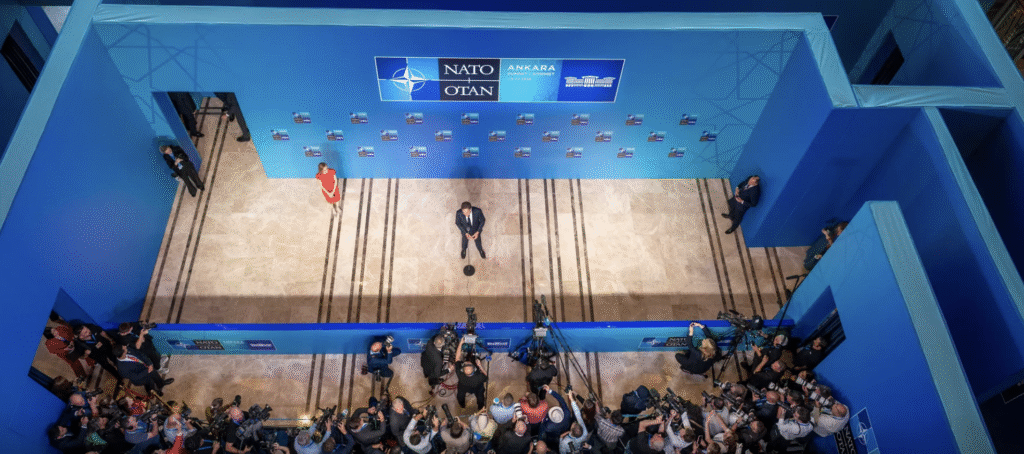
At the NATO summit in Ankara, Secretary General Mark Rutte pushed back on U.S. complaints that European allies were not supporting Washington's campaign against Iran. He argued that allied basing access and thousands of sorties from European facilities remain central to U.S. power projection even as political strains widen inside the alliance.
|
|
DEFENSE
The Hill reports that the Trump administration justified its latest strikes on Iran as a response to attacks on three commercial oil vessels in the Strait of Hormuz. According to the administration's account, the operation hit more than 80 targets including air defenses, command networks, radar sites and anti-ship missile capabilities, underscoring the rapid escalation around the waterway.
|
|
|
|
|
STRATO BRIEF
|